Risk buried in volume
Imaging, labs, vitals, and clinical context arrive inside a crowded ED workflow. Caire surfaces configured signals for clinician review.
Imaging Intelligence Immediately
The Intelligence Layer for Emergencies
Caire turns clinical data and diagnostic imaging into timely, structured intelligence—helping emergency teams triage risk, accelerate care, and discharge appropriate patients sooner.
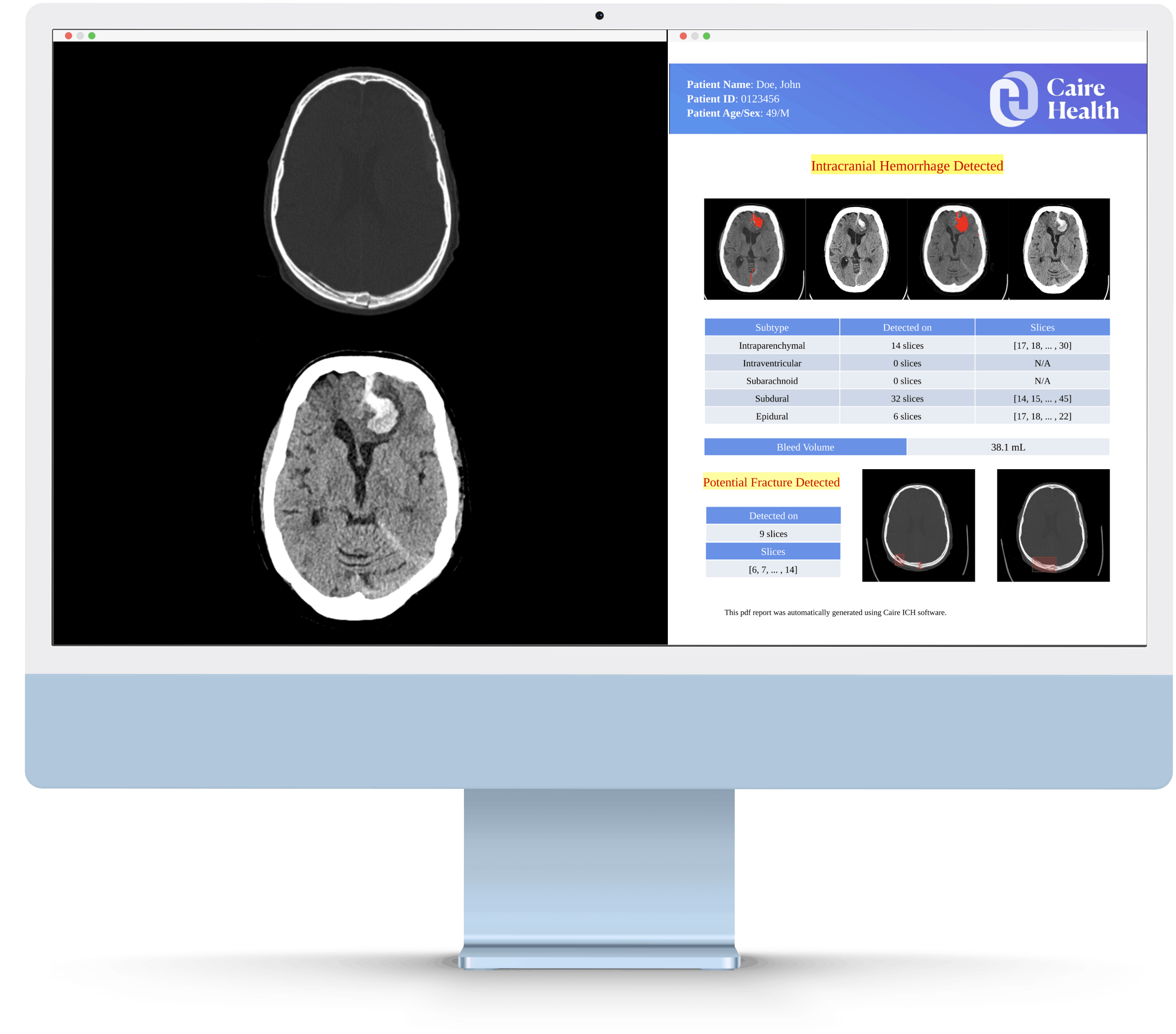
Caire ICH product interface
One urgent problem
Emergency care moves across separate queues, screens, calls, and teams. Caire reduces that fragmentation without asking clinicians to abandon the tools they already use.
Imaging, labs, vitals, and clinical context arrive inside a crowded ED workflow. Caire surfaces configured signals for clinician review.
Measurements, images, prior history, and team communication often live in different systems. Structured outputs create a shared starting point.
When risk is time-sensitive, information should follow the care pathway—across emergency medicine, radiology, specialty services, transfer teams, and inpatient care.
The Caire platform
A modular emergency intelligence platform connecting clinical analysis, triage, workflow orchestration, disposition support, and operational learning.

Evaluate available diagnostic inputs for configured patterns associated with time-sensitive conditions.

Organize suspected findings by type, location, severity, and available patient context for rapid review.

Present relevant measurements, severity indicators, and risk context when available.

Trigger site-defined alerts and escalation pathways based on findings, location, service line, and coverage.

Connect through DICOM, HL7, FHIR, PACS, RIS, EHR, and worklist infrastructure.

Measure pathway intervals and surface where operational delays accumulate across sites and shifts.
Built around the care team
Caire is designed as connective tissue—not another destination. Each team sees the information it needs while maintaining the clinician as the decision-maker.
Diagnostic data follows the existing clinical workflow. Caire receives the minimum relevant inputs in the background.
Models evaluate available inputs and produce traceable, structured outputs for authorized users.
Configured care teams receive the same patient context through the systems and channels they use.
Teams move patients toward treatment, observation, admission, transfer, or discharge while sites monitor pathway performance.
Peer-reviewed evidence
Published retrospective studies have evaluated Caire ICH as a standalone algorithm and as an assistive tool for radiologists and emergency physicians.
Retrospective study results; cohorts and limitations differ. See the Evidence page for study context and source publications.
Voice of the customer
Clinical teams use Caire to bring relevant insight into the moments where speed, judgment, and coordination matter most.
“Caire Health helped us turn fragmented clinical information into something our team could actually use at the point of care. The platform made it easier to understand patient risk, coordinate next steps, and make more informed decisions without adding extra administrative burden.”
“Caire Health gave our care team greater confidence when reviewing complex cases. Having relevant insights available in one place helped us move faster while still feeling thoughtful and clinically grounded.”
“The biggest impact has been efficiency. Tasks that used to require manual review and back-and-forth communication are now much easier to manage. It has improved both our workflow and our ability to deliver timely care.”
“Our clinicians appreciated that the system fit naturally into how they already work. Adoption was smoother than expected because the platform supported clinical decision-making rather than disrupting it.”
“Caire has meaningfully improved the way our team handles urgent imaging. The platform fits naturally into our existing workflow and helps ensure that critical studies are surfaced quickly and consistently. What has impressed us most is how little friction there was in adopting it. The technology feels practical, dependable, and designed around how clinicians actually work.”
“Caire has become an important part of our clinical workflow. It gives our team greater confidence that time-sensitive findings are being identified and communicated promptly, particularly during high-volume periods. The implementation was straightforward, the system has been easy for our staff to use, and the Caire team has been exceptionally responsive throughout our experience.”
Start a conversation